
Monitoring Account Activity with Audit Logs
Collaborating on link management and marketing campaigns requires transparency. Whether you are troubleshooting an unexpected change or reviewing team activity for compliance, Audit Logs provide a detailed history of actions taken within your account.
With Audit Logs, you can see who created, edited, or deleted URLs, UTMs, projects, and other resources. This transparency is available at both the high-level account view and for individual items.
1. Accessing Account-Wide Audit Logs
The Account-Wide log provides a high-level overview of all activity performed by every user within your account.
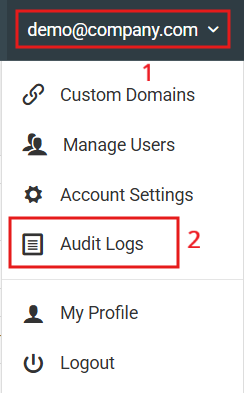
- From the top navigation menu, click your account name or icon in the top-right corner.
- Select Audit Logs from the dropdown menu.
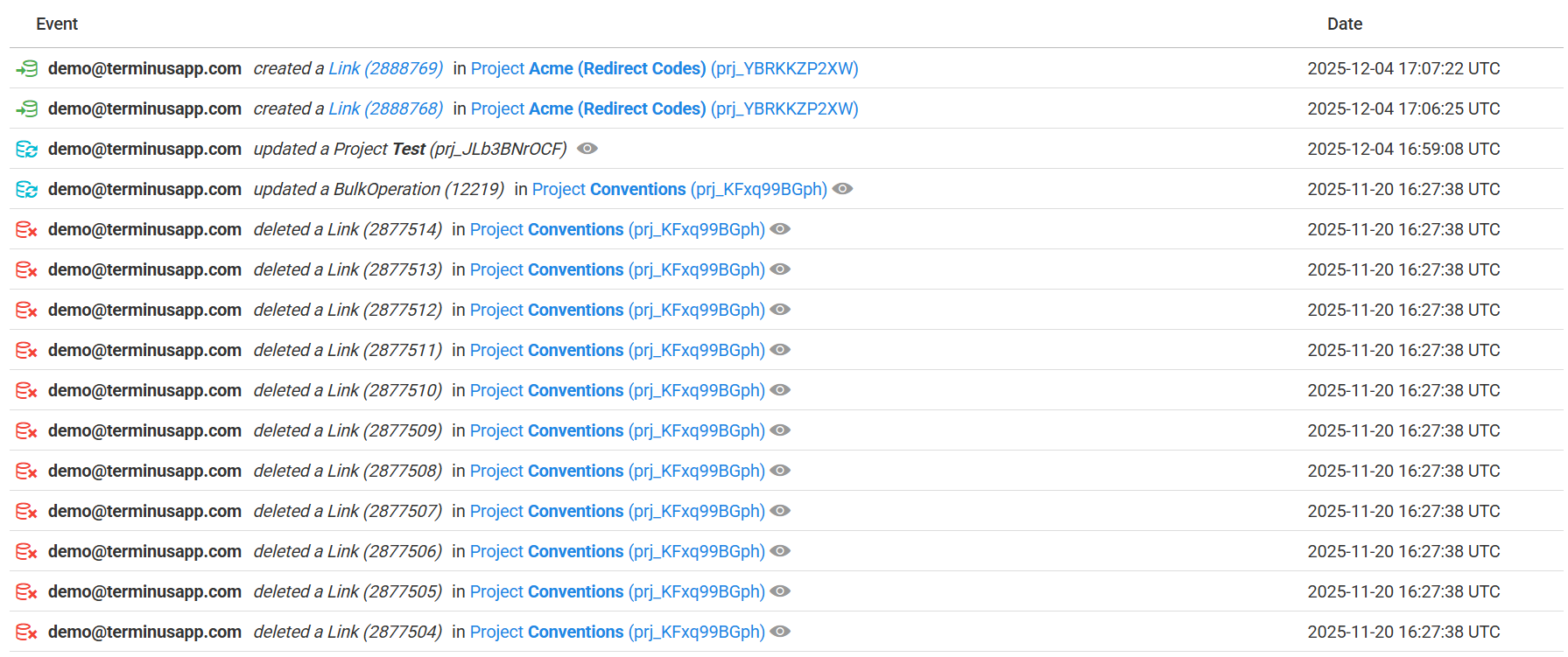
- By default, the dashboard displays activity from the Last 30 Days. You can see who did what, and when.
NOTE: The Audit Logs section is only accessible to users with Administrator privileges. If you don't see this option, please contact your account administrator for access.
1.1. Viewing Event Details
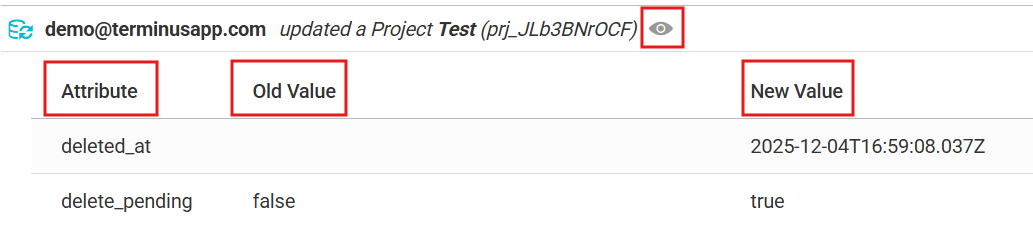
To investigate a specific action i.e., Update or Delete, click the Eye icon (View Details) next to the log entry. This opens a panel with granular technical data, allowing you to understand exactly how the data changed. A detailed table breaks down the event into three key columns:
- Attribute: The specific field or setting that was changed (e.g., status, URL, name).
- Old Value: The data as it existed before the event.
- New Value: The data as it exists after the event.
Example:
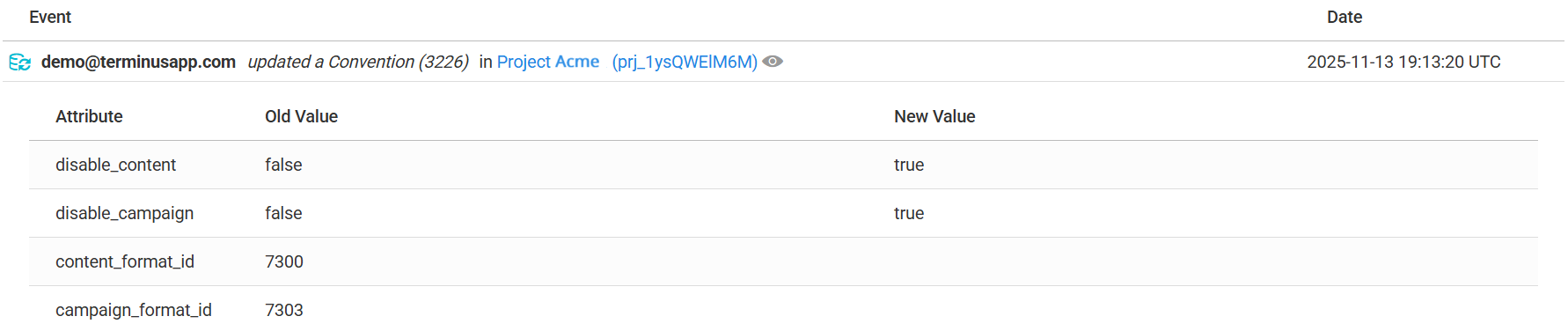
The user [email protected] updated a Convention in Project named Acme.
Log Details:
- Event: updated a Convention in Project Acme
- Time: 2025-11-13 19:13:20 UTC
Attribute Breakdown:
- Attribute: disable_content, disable_campaign
- Old Value: false (The UTM parameter was not active).
- New Value: true (The UTM parameter is now active).
- Meaning: This switch confirms that the UTM parameters are enabled.
- Attribute: content_format_id, content_campaign_id
- Old Value: 7300, 7303
- New Value: ‘’
- Meaning: The id has been removed from the UTM parameters.
2. Filtering and Exporting Data

To find specific events efficiently, you can use the filter bar at the top of the Audit Logs page. This helps you narrow down activities by time, user, or specific action.
Available Filters:
- Time Range: Select a specific duration (e.g., Last 24 Hours, Last 7 Days, or Last 30 Days).
- Item Type: Filter by the specific resource modified, such as Campaign, Link, Preset, ApiKey, or CustomDomain.
- Event: Filter by the type of action taken: Create, Update, or Destroy (Delete).
- Item ID: Search for a specific resource using its unique ID.
- Email: Input a user's email address to see a history of actions performed by that specific team member.
Applying Filters: Once you have selected your criteria, click the blue Filter button to update the list. To reset your view, click Clear Filters.
Exporting Logs: For compliance reporting or offline analysis, you can download the current view by clicking the Export CSV button located next to the filter options.
3. Item-Specific Audit Logs
For a granular history of a single URL or UTM parameter, you can access its individual audit log.
3.1. For a URL:
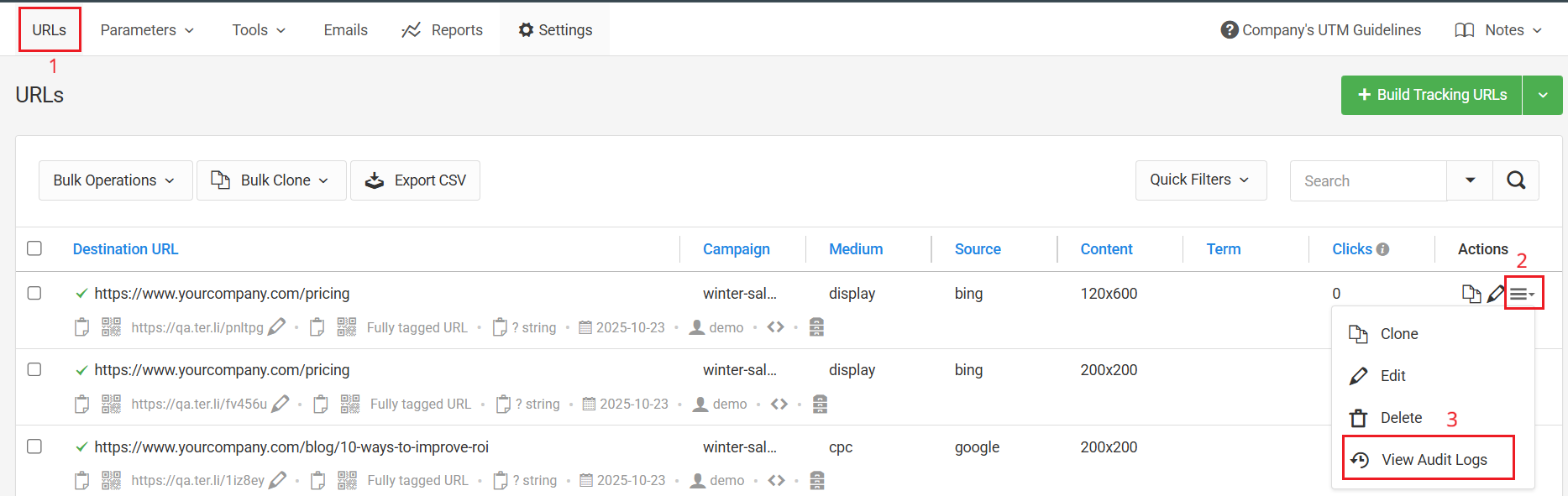
- Navigate to the URLs dashboard.
- Locate the URL you want to investigate and click on the three lines under the Actions column.
- Select View Audit Logs from the dropdown options. This will show you a complete history of all changes made to that specific URL.
3.2. For a UTM Parameter:
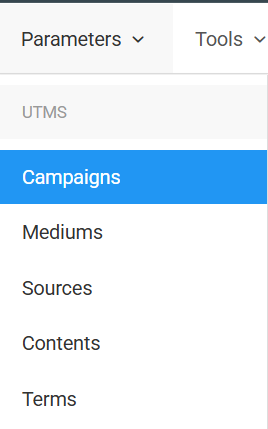
- Navigate to Parameters> Campaign.
- Locate the specific campaign you want to review (e.g., 20percent).

- Click on the View Audit Logs icon next to that campaign to see all changes made to its settings.
This two-level approach allows both high-level administrative oversight and detailed, item-specific troubleshooting.
Best Practices
- Troubleshooting: If a link stops working unexpectedly, check the Event filter for "Update" or "Destroy" to see if a configuration was recently changed.
- Security: Periodically review logs filtered by ApiKey or AccountMembership to ensure sensitive access points have not been modified without authorization.